
Bucharest is the capital and the largest city in Romania. At the census in 2002, its population was over 1.9 million. The metropolitan area of Bucharest has a population of about 2.2 million. There are several plans to increase further its metropolitan area to about 20 times the area of the city proper.
There are 5 more cities in Romania, with a population of around 300,000, that are also present in EU top 100 most populous cities. These are: Iaşi, Cluj-Napoca, Timişoara, Constanţa, and Craiova. The other cities with populations over 200,000 are Galaţi, Braşov, Ploieşti, Brăila and Oradea. Another 13 cities have populations over 100,000.
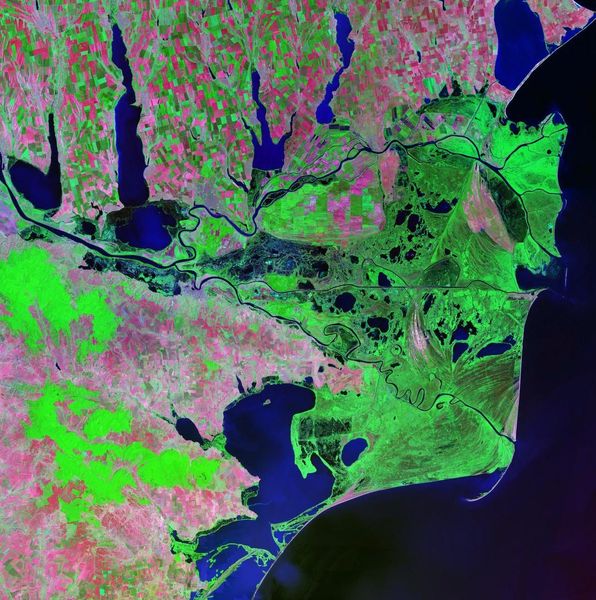
| Danube delta - source |

Until now, several of the largest cities have a metropolitan area: Constanţa (550,000 people), Braşov, Iaşi (both with around 400,000) and Oradea (260,000) and several others are planned: Timişoara (400,000), Cluj-Napoca (400,000), Brǎila-Galaţi (600,000), Craiova (370,000), Bacau and Ploieşti.
With a surface area of 238,391 km², Romania is the largest country in southeastern Europe and the twelfth-largest in Europe. A large part of Romania’s border with Serbia and Bulgaria is formed by the Danube. The Danube is joined by the Prut River, which forms the border with the Republic of Moldova. The Danube flows into the Black Sea within Romania’s territory forming the Danube Delta, the second largest and the best preserved delta in Europe, and a biosphere reserve and a biodiversity World Heritage Site. Other important rivers are the Siret, running north-south through Moldavia, the Olt, running from the oriental Carpathian Mountains to Oltenia, and the Mureş, running through Transylvania from East to West.
Romania’s terrain is distributed roughly equally between mountainous, hilly and lowland territories. The Carpathian Mountains dominate the center of Romania, with fourteen of its mountain ranges reaching above the altitude of 2,000 meters. The highest mountain in Romania is Moldoveanu Peak (2544 m). In south-central Romania, the Carpathians sweeten into hills, towards the Bărăgan Plains. Romania’s geographical diversity has led to an accompanying diversity of flora and fauna.
Environment
A high percentage of natural ecosystems (47% of the land area of the country) is covered with natural and semi-natural ecosystems. Since almost half of all forests in Romania (13% of the country) have been managed for watershed conservation rather than production, Romania has one of the largest areas of undisturbed forest in Europe. The integrity of Romanian forest ecosystems is indicated by the presence of the full range of European forest fauna, including 60% and 40% of all European brown bears and wolves, respectively. There are also almost 400 unique species of mammals (of which Carpathian chamois are best known), birds, reptiles and amphibians in Romania.
There are almost 10,000 km² (almost 5% of the total area) of protected areas in Romania. Of these, Danube Delta Reserve Biosphere is the largest and least damaged wetland complex in Europe, covering a total area of 5800 km². The significance of the biodiversity of the Danube Delta has been internationally recognized. It was declared a Biosphere Reserve in September 1990, a Ramsar site in May 1991, and over 50% of its area was placed on the World Heritage List in December 1991. Within its boundaries is one of the most extensive reed bed systems in the world. There are two other biosphere reserves: Retezat National Park and Rodna National Park.
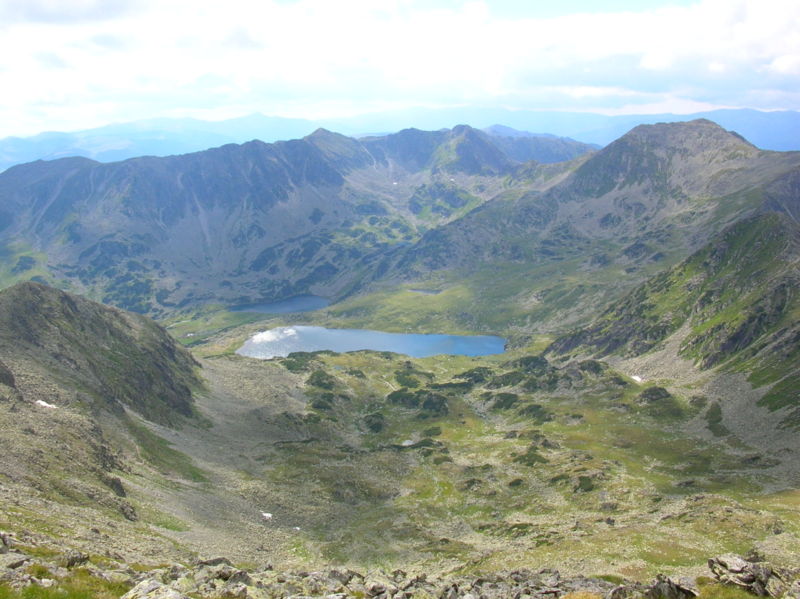
| Retezat National Park - source |

Tourism focuses on the country’s natural landscapes and its rich history and is a significant contributor to the Romania’s economy. In 2006, the domestic and international tourism generated about 4.8% of gross domestic product and 5.8% of the total jobs (about half a million jobs). Following commerce, tourism is the second largest component of the services sector. Tourism is one of the most dynamic and fastest developing sectors of the economy of Romania and characterized by a huge potential for development. According to the World Travel and Tourism Council Romania is the fourth fastest growing country in the world in terms of travel and tourism total demand with a yearly potential growth of 8% from 2007-2016. Number of tourists grew from 4.8 million in 2002 to 6.6 million in 2004. Similarly, the revenues grew from 400 million in 2002 to 607 in 2004. In 2006, Romania registered 20 million overnight stays by international tourists, an all-time record, but the number for 2007 is expected to increase even more. Tourism in Romania attracted €400 million in investments in 2005.
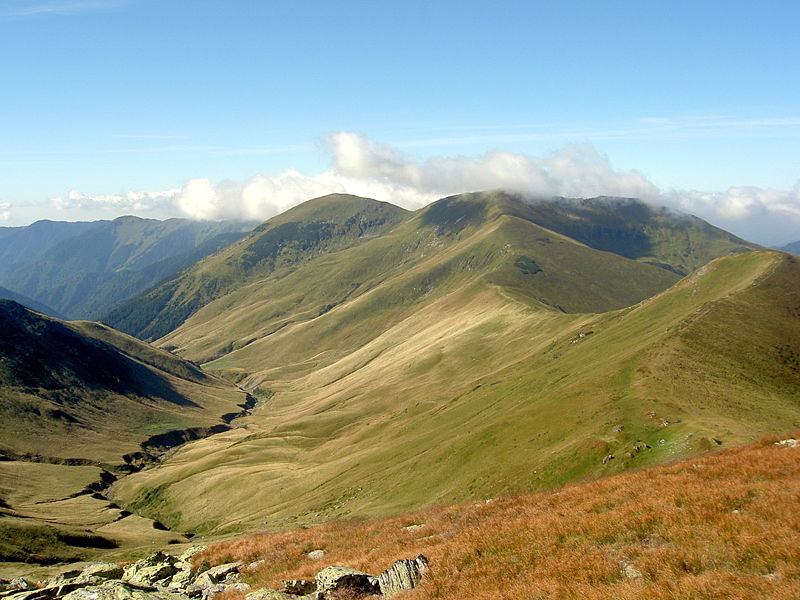
| Rodna National Park. - source |

Over the last years, Romania has emerged as a popular tourist destination for many Europeans (more than 60% of the foreign visitors were from EU countries), thus attempting to compete with Bulgaria, Greece, Italy and Spain. Romania destinations such as Mangalia, Saturn, Venus, Neptun, Olimp, Constanta and Mamaia (sometimes called the Romanian Riviera) are among the most popular attraction during summer. During winter the skiing resorts along the Valea Prahovei and Poiana Braşov are booming with visitors. Several cities in Transylvania (such as Sibiu, Braşov, Sighişoara, Cluj-Napoca and several others) have become important touristic attractions for foreign tourists - especially for their medieval atmosphere and castles. Rural tourism focused on folklore and traditions, has become a major issue for the authorities recently, and is targeted to promote such sites as Bran and its Dracula’s Castle, the Painted churches of Northern Moldavia, the Wooden churches of Maramureş, or the Merry Cemetery in Maramureş County. There are several major natural attractions in Romania - such as Danube Delta, Iron Gates (Danube Gorge), Scărişoara Cave and several other caves in the Apuseni Mountains - that have not received great attention from the authorities and whose potential has not been fully tapped.
Unique places
Berca Mud Volcanoes - a geological and botanical reservation located in the Berca commune in the Buzău County in Romania. Its most spectacular feature is the mud volcanoes, small volcano-shaped structures typically a few meters high caused by the eruption of mud and volcanic gases.
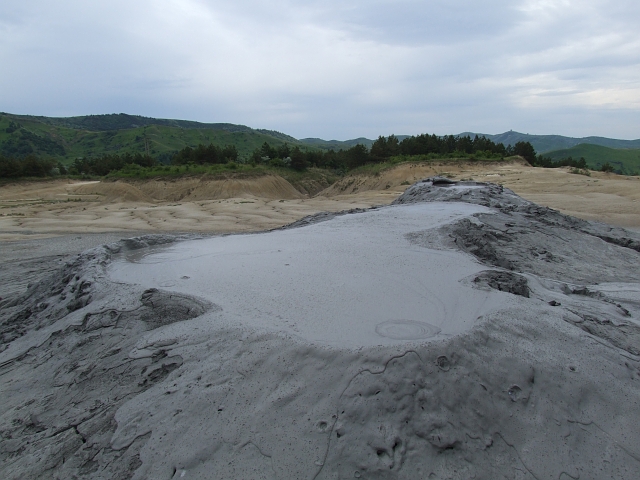
| Berca Mud Volcanoes - source |

Scărişoara Cave - one of the biggest ice caves in the Romanian part of Carpathians, more specifically in the Apuseni Mountains.
Merry Cemetery - a cemetery in the village of Săpânţa, Maramureş county. It is famous for its colourful tombstones with native paintings describing, in an original and poetic manner, the persons that are buried there as well as scenes from their lives. The Merry Cemetery became an open-air museum and a national tourist attraction.
Palace of the Parliament - the home of the Romanian Parliament in Bucharest.
Transfăgărăşan - Built as a strategic military route, it is the highest and most dramatic paved road in Romania. It runs North to South across the tallest sections of the Carpathian Mountains, between the highest peak in the country, Moldoveanu, and the second highest, Negoiu. The road connects the historic regions of Transylvania and Wallachia, and the cities of Sibiu and Piteşti. (Burford, 2006)
The richness and variety of Romanias tourist attractions, natural but also cultural and historical ones, bring Romanian a leading position in Europe. Romanian’s location at a crossroads of many European roads facilitates access by all means of transport - by plane, car, train or ship.
Lot of travel information, reserve a hotel, rent a car rent a helicopter.
Trip around the country? … Impossible without a maps of Romania!
If you are interested in planning the whole trip across the country you will surely need sort of maps of the country. At the link below there is the source of geographical maps
Sea resorts, castles, fortresses, rivers, towns, monasteries, spas – basically places to visit.
At the link below you will find a huge stuff of information which you might use when you decide to travel to Romania such as Black sea resorts, castles and fortresses, danube Delta , Medieval Towns, Painted Monasteries, Spas and The Countryside, architecture and many others
Tourist info which should be in your diary
List of addresses of tourist information offices, where can you receive information in your mother language including the list of phone numbers.
Activity and Sport
Are you interested in rafting, skiing, cycling, golf, fishing or other kinds of sports?
Romania has a lot to offer...
Gallery of the Romania places
Here is the link of some sample images from Romanian places, objects which you surely have to know before you go to visit this country: