
Cyprus is one of the most beautiful islands in the Eastern Mediterranean Sea situated south of Turkey, west of the Levant, north of Egypt, and east southeast of Greece. Cyprus is the third largest island in the Mediterranean (after Sicily and Sardinia), with an area of 9.251 square kms (roughly 3.570 miles). A full member of the European Union since year 2004, Cyprus’ infrastructure is of a high standard with excellent utility, medical, vehicular roads and telecommunications services. Commuting is made easy by the two airports in Cyprus -Larnaca International Airport and Pafos International Airport. Cyprus established itself as a international business centre because of his strong financial system. Cyprus has 9.000 years of legend and history. It is a land of beauty and vivid contrasts; from pine-clad mountains to sunny beaches and small villages to cosmopolitan towns. Its beautiful scenery and enviable climate, along with European culture and ancient enchantment beckon many to its shores. Cyprus has been at the crossroads between Europe, Western Asia, and Northern Africa , with lengthy periods of mainly Greek and intermittent Anatolian, Levantine and British influences. Though these influences may cause some to consider Cyprus as a transcontinental island, such a term is properly applied only to nations whose boundaries straddle more than one continent e.g. Turkey, Russia and Egypt. The major cities in Cyprus are the capital Nicosia (Lefkosia in Greek, Lefko?a in Turkish), Limassol (Lemesos in Greek), Larnaca, Paphos, Famagusta (Gazima?usa or Ma?usa in Turkish, Ammochostos in Greek), and Kyrenia (Girne in Turkish, Kerynia in Greek).
Cyprus is part of the Mediterranean climate zone, and so benefits from short mild winters and long dry a warm summers. The island is famed for its sunshine and its long swimming season. In the Troodos Mountains, the temperature regularly falls below freezing near the mountaintops.
LIMASSOL
Limassol is the largest seaside report and important centre of Cyprus, about 70 km from Larnaca. It is the island’s second largest city with a population of 135.000 and largest seaside resort spreading ten miles along the south coast. Acting as a magnificent backdrop to the city are the Troodos mountains, in whose fertile foothills most of the country’s grapes are grown making Limassol the centre of the island’s wine-making industry. The town’s carefree holiday atmosphere, seafront promenade and bustling streets, is matched by the friendly and lively character of its people. It offers the full gamut of shopping from impressive international boutiques to traditional handcraft centres. The city is renowned for its long cultural tradition and hosts a wide spectrum of activities. A fort was constructed in the 14th century, replacing a Byzantine castle.

| source |

LARNACA
Larnaca is the biggest city of the eastern part of Cyprus. Larnaca is famous for its history. Its Neolithic archaeology stands out in the eastern Mediterranean. In the surrounding of the centre you can find a lot of beautiful mountain villages, old-time churches and original developments. Larnaca also attracts tourists due to its lovely sandy beaches, limpid sea and charming vegetation.
PAPHOS
This tourist resort is situated on the southwest part of island and it is famous for its archaeological finds from 3.-5. Century. Paphos is on UNESCO’s World Heritage list. In the harbour is a dominating stronghold (formerly part of castle system), where Richard the Lionheart stayed. Interesting are the tombs of Kings in Kato Pafos. The city’s climate favours banana cultivation. Nearby is a Petra tou Romiou beach where Aphrodite is said to have been born from the waves.
| source |

FAMAGUSTA
A one time Famagusta was one of the richest cities in the world. The town lies on a destitute peninsula; there are beautiful 16th century temples.
KYRENIA
This northern coast town is renowned for it natural beauty. One finds the ruin of the 10th century Sant Hillarion castle, and the ruin of Buffavento stronghold.
AGIA NAPA
Agia Napa is the favourite seaside resort with amazing sandy beaches (where is a possibility to try a lot of water sports), full of restaurants, disco clubs, typical taverns with local kitchen and shops. Airport in Larnaca is not so far away (about 40 km).
| source |
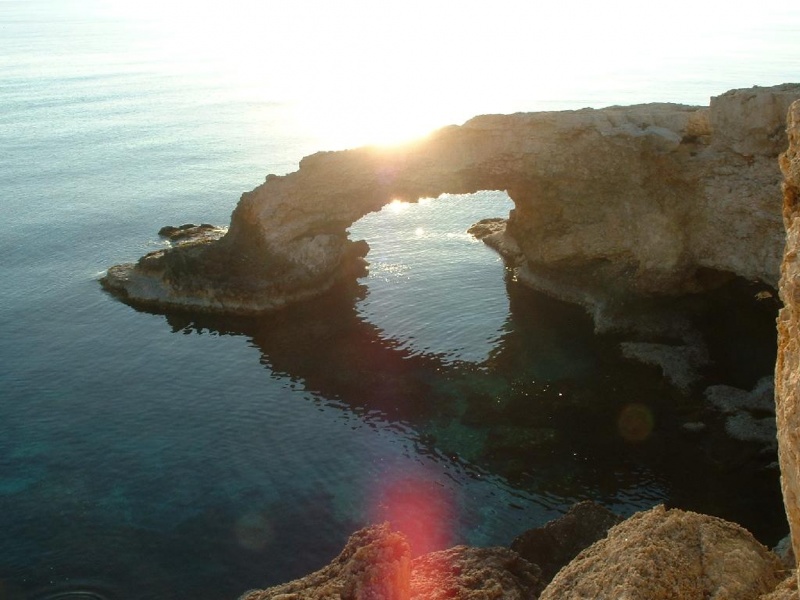
Cyprus’ sea water ranks among the cleanest and hottest waters in the Mediterranean. Many local beaches have been awarded. Probably, the most beautiful beaches are those in Agia Napa and Protaras. Even the hotel beaches are public.
LOW CRIME
The crime rate in the Cyprus is low in comparison with other Mediterranean countries. Cyprus crime rate is only one tenth of the average rate of the other European countries. You will find that people rarely lock their cars, often, doors and windows are left open. The local population is friendly and honest, offering a feeling of security to the visitor.
NIGHT LIFE
Cypriots are said to regard food as their hobby. Eating out is part of their entertainment. Restaurants offer a variety of tastes from international cuisine including Japanese, Russian, Mexican. The local taverns offer Greek meze dishes and local live music.
Tourism dominates Cyprus’ economy.
In 2006 around 2.400.000 people visited Cyprus – most of them from the United Kingdom, Germany, Greece, Russia and Sweden.
Some guiding web pages on tourism: